
“Our hospitals are already at the brink,” said CNN medical analyst Dr. Leana Wen, a former Baltimore City health commissioner. “And they are just at the brink of becoming so overwhelmed that patients are going to get less than ideal care.”
Already stretched thin, experts and health care workers fear things will only get worse, with a potential surge of infections fueled by Thanksgiving travel and gatherings.
Just one week after the holiday, the US has yet to feel the full effects. But Wen said we will see an “exponential rise” in cases in the next few weeks, and she urged Americans do their part to combat the spread of the virus and relieve the strain on hospitals.
“Because otherwise we have a catastrophe on our hands that’s worse than any of us can possibly imagine,” she said.
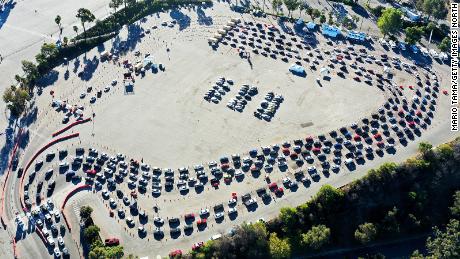
December has brought the highest hospitalization numbers in the US since the pandemic began as the virus continues to spread like wildfire.
More than 14.7 million confirmed cases had been reported in the US as of Sunday night, and more than 282,200 people have died.
As of Saturday, the US averaged 190,948 new cases over the last week, another record high, according to a CNN analysis of Johns Hopkins data.
Millions of Californians face stay-at-home orders Sunday
New restrictions will go into effect at 11:59 p.m. PT for large portions of California, including the Southern California and the San Joaquin Valley regions, after intensive care unit capacity dropped below 15%, triggering a mandate issued by Gov. Gavin Newsom last week.
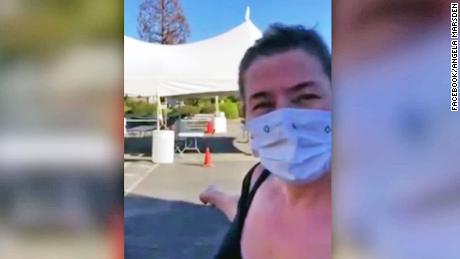
The orders come as Los Angeles County on Sunday reported more than 10,500 new cases in one day, surpassing the 10,000 mark for the first time. Statewide, there were more than 30,000 new cases, the highest ever recorded in the state.
Under the orders, businesses like bars, hair salons, museums, movie theaters and indoor recreational facilities will be forced to close. Restaurants will be limited to takeout and delivery service while retail businesses can continue to operate at 20% capacity.
Schools already open for in-person learning can stay open, along with other critical infrastructure businesses.
Orders there will begin to go into effect Sunday, with Alameda County’s restrictions beginning Monday and Marin putting restrictions in place on Tuesday. Restrictions will remain in place until at least January 4, 2021.
Adults must get vaccinated for students to return to school
It will likely be months before all adults in the US can be vaccinated against the virus, and the wait will be even longer for children — but they can still be protected by vaccine distribution, said Dr. Robert Wachter, chairman of the department of medicine at University of California, San Francisco.
Wachter says that if adults get vaccinated, children could reap the benefits.
“If we can get everybody else vaccinated — we can get all the adults vaccinated and get the virus to die out because we get somewhere near herd immunity — the kids may be less important.”
“I think it’s reasonable to expect that the kids will be back in school in the fall, not so much because all of them have been vaccinated — although I hope they will — but everybody around them has been vaccinated, and the rate of virus in their communities has fallen to a point that is perfectly safe for them to be in school,” Wachter said.
Kids are likely to be vaccinated relatively late in the game because Covid-19 vaccines are largely untested on children. The National Vaccine Advisory Committee voted Friday not to recommend emergency use of a Covid-19 vaccine in children, noting that children generally experience a milder version of the disease.
Vaccine chief hopes for drop in elderly Covid-19 deaths
Moncef Slaoui, chief scientific adviser for the public-private vaccine program known as Operation Warp Speed, said he hopes to see a “quite significant” drop in coronavirus illness and death among the elderly population by January’s end.

By the middle of March, he said, the United States should have vaccinated its highly susceptible population, which is about 100 million people, while the rest of the country “will not all have the vaccine in our arms before May or June.”
Manufacturing the vaccine has been “somewhat more complicated and more difficult than we planned,” Slaoui said, adding that scientists are six to eight weeks behind “an ideal scenario where we would have had 100 million doses by the end of this year.” The nature of fast-tracking a vaccine means more issues may arise, he said.
“This is not an engineering problem. These are biological problems. They are extremely complex, and we don’t control 100% of everything as it happens,” he said. “There will be small glitches.”
The vaccine, which will come in two doses — a challenge to produce and distribute in the necessary quantities — will likely reach healthy, non-elderly Americans with no known underlying health conditions in late March to early April, said Dr. Anthony Fauci, director of the National Institute of Allergy and Infectious Diseases.
CNN’s Tina Burnside, Ana Cabrera, Andrea Diaz, Maggie Fox, Anastasia Graham-Yooll, Jacqueline Howard, Christina Maxouris, Eliott C. McLaughlin, Jon Passantino, Jake Tapper, Naomi Thomas, Paul Vercammen and Fredricka Whitfield contributed to this report.