
Representational Image
(IANS)
Growing mental health challenges aren’t something new, but the COVID-19 pandemic and the subsequent lockdowns turned the spotlight on them. According to a report by the World Health Organisation, the global prevalence of anxiety and depression spiked by a whopping 25% during the first year of the COVID-19 pandemic. Some prominent reasons for this unprecedented stress were social isolation, fear of infection, loss of loved ones and financial worries.
Fortunately, we are now towards the end of the pandemic, but mental health-related issues still persist and could form the next major public health concern across the globe. The question is, have we reached a place where we can talk about such personal challenges and issues openly, and what steps should we take to safeguard our mental well-being?
On this World Mental Health Day, The Weather Channel hosted a panel discussion on Twitter with renowned psychiatrists Dr Samir Parikh and Dr Ashutosh Singh and school psychologist Geetika Kapoor, hoping to understand current challenges, countermeasures, and key areas of focus.
Here are the key takeaways from the discussion that resonated with our listeners:
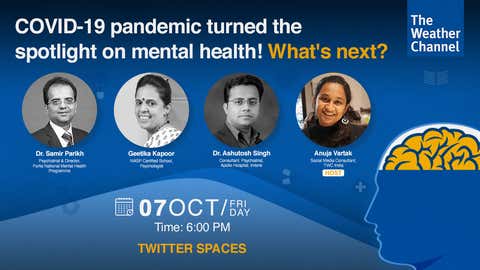
Twitter Spaces- Mental Health
(TWC Edit Team)
Government’s role in addressing mental health challenges
The pandemic not only turned the spotlight on mental health but also propelled researchers to conduct focused studies and the government to take initiatives to raise awareness around this subject. As a result, the topic became a matter of utmost concern and active dialogue across India and worldwide.
“The government’s involvement in prioritising mental health by utilising a part of the Budget 2022 in the National Tele-Mental-Health programme kickstarted a much-needed open dialogue among masses of the society,” said Dr Ashutosh Singh, a consultant psychiatrist & a de-addiction specialist at Apollo Hospitals Indore.
“However, it currently lacks decentralisation of services at a district level, and the focus is more on a national level. This being said, Madhya Pradesh has become the first state to establish a committee to formulate a suicide prevention policy for the state residents,” he added.
The panellists also appreciated the role of the National Tele-Mental-Health programme in creating mass awareness and providing better access to nooks and corners of the country. However, they did highlight the importance of better regulation of the programme to help psychiatrists and service providers as well.
Reforming workplaces for the mental well-being of employees
The work-from-home culture helped employees take care of their families without jeopardising their productivity in most cases. At the time, several studies and reports pointed out that the instances of burnout spiked drastically. As we now transition back to the office or continue a hybrid policy, we asked expert Dr Samir Parikh, a psychiatrist and the Director of the Department of Mental Health at Fortis Healthcare, about how companies could safeguard the mental wellness of their employees.
According to Dr Parikh, an end-to-end mental health solution is crucial for the mental wellness of workers. Awareness building, early identification of psychological problems, accessibility to psychological first aid, and the involvement of the insurance sector are some of the basics, he suggested.
Dr Singh added that companies must trust their employees whenever someone speaks up or opts for a break for mental health reasons. He shared examples of employers reaching out to him to reconfirm his patient’s conditions for approval of leaves and explained how such practices could affect the wellness goals of the entire workforce.
Personality shifts among young adults due to the pandemic
The pandemic-induced lockdowns and physical distancing became a boon for some young adults and a bane for others. While some flourished in the boundaries of their houses, others grappled with the uncertainty of the future and infinitely prolonged distancing from the world.
“Many students with whom I work reached their best potential during the lockdown since they could avoid the excessive pressure of mingling with people,” expressed Geetika Kapoor, a school psychologist. But for students to transition into a more socially interactive world than they were two years ago, self-acceptance and embracing individual strengths and weaknesses is the key, suggested Geetika.
Identifying the signs of burnout and exhaustion
The pandemic changed many things, including the never-ending ‘work-from-home’, spike in social media use, binge-watching, and the growing hustle culture. However, this also entailed a sharp spike in cases of work-related anxiety, burnout, and chronic exhaustion, “While it could be hard to identify the signs of burnout in oneself, keeping an eye on your productivity levels and interactions in your social circle is a great way to keep a check on your mental wellness,” said Dr Singh.
Geetika Kapoor further stressed the imbalance of mind and body that results in fatigue, both mental and physical. “Our mind is capable of doing more things than our body can cope with. So once the balance between the mind and the body is lost, exhaustion can easily kick in. Such unreasonable burnouts can be avoided if we start listening to our bodies early on and build our habits accordingly,” elaborated Geetika.
On this World Mental Health Day (October 10), the World Health Organisation (WHO) invites us to make mental health and well-being for all a global priority. As stigma and discrimination form major barriers to social inclusion and access to better care, awareness plays a huge role in preventive mental health interventions. This day provides an opportunity to do that collectively!
The entire conversation can be accessed here.
**
For weather, science, space, and COVID-19 updates on the go, download The Weather Channel App (on Android and iOS store). It’s free!