
Highest
level of political leadership in Covid response is indeed
unprecedented if we look at other health responses such as
those for HIV, non-communicable diseases, TB or other
communicable diseases that affect our lives. But were people
having any voice in helping shape the response to the corona
virus pandemic? To what extent did governments adapt
important game-changing learnings over the past decades from
several other health and development
struggles?
Incidentally, a few days after the world
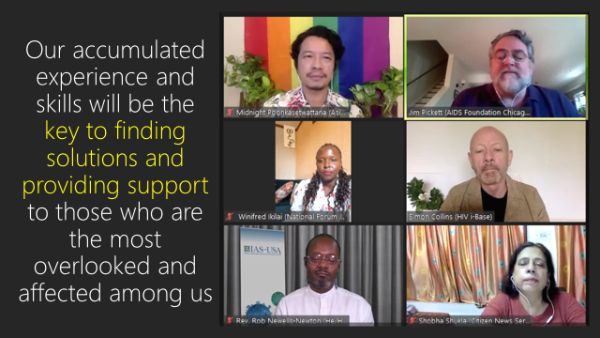
celebrated Juneteenth to mark end of slavery, a Webinar
hosted by International Antiviral Society (IAS) USA had put
spotlight on “Nothing Without Us: Civil Society Solutions
to the COVID-19 Pandemic”. Inequities and social
injustices that have plagued most of our population, has
only allowed tiny number of rich elites to amass enormous
wealth and power. When the public health emergency ensued
with the spread of the corona virus, these very inequities
and social injustices not only got exposed but were
dangerously pronounced thereby crippling the
response.
COVID Advocates Advisory Board
(CAAB)
Jim Pickett, co-founder of International
Rectal Microbicides Advocates and Senior Director of
Prevention Advocacy at the AIDS Foundation of Chicago, who
was moderating the session, said that biomedical strategies
to diagnose, prevent, and treat COVID-19 are urgently
needed, and efforts to rapidly develop these tools are
underway worldwide. Accelerated research enhances the need
for civil society input to ensure ethical development and
access to these tools worldwide to ensure social justice. In
this context, community engagement necessitates innovative
structures, mechanisms, and actions, said Jim while
explaining the key role for the COVID Advocates Advisory
Board (CAAB) which currently connects over 125 people
worldwide. CAAB’s efforts are directed towards the
achievement of social justice, health equity and the defense
of human rights, said Jim.
Like HIV, COVID too has
hit communities of colour the hardest
Social and
racial injustices and inequities that COVID has brought to
the forefront has also resulted in the grim reality that
many racial and ethnic communities are at heightened risk of
getting sick and dying from COVID, such as, people of
colour. These social determinants of health have
historically prevented them from having fair opportunities
for economic, physical, and emotional health.
Rob
Newells, Director of National Programmes for Black AIDS
Institute, said that they rose to the challenge early in the
pandemic. Interventions like delivering groceries to the
people in need, and more importantly, getting the right
information to the communities also became a priority.
“Each one, teach one! It boils down to empowering others
to tell the stories,” Rob said, who is doing his best to
ensure that people themselves become the messenger and
harbinger of right information that empowers them and their
fellow beings.
Rob also commented on vaccine hesitancy
or medical mistrust that affects the response to COVID.
“Our role is to honestly answer every single question so
that people are informed enough to make the right
decision” he said. “People will listen to folks they
trust”. Guilt or shame had also affected people living
with HIV, but sadly we have not learnt much from the HIV
response because people with COVID are also dealing with
these issues.
Rob Newells said that we should not lose
good interventions that came up during COVID such as
implementation of telehealth for primary healthcare as well
as for mental health. Broadband internet access everywhere
and for everyone should also become a priority.
Power
of communities in shaping solutions
Top-down
responses by governments fail to leverage the resilience and
power of communities to play a role in shaping an effective
response to a problem that affects them most. “It is
important to recognize the power of communities when they
take ownership of their well-being and realize the value of
their agency in shaping solutions to problems. One example
is from networks of people living with HIV in India who
could foresee a possible lockdown 7-10 days before it got
clamped at 4 hours’ notice” said Shobha Shukla, a fierce
feminist and development justice leader and founder of CNS
(Citizen News Service). “HIV community networks played a
central role in ensuring uninterrupted access to HIV
treatment during India’s COVID-19 lockdown.”
“Days
before the lockdown got imposed, the National Coalition of
People Living with HIV (NCPI+) as well as Delhi Network of
Positive People (DNP+) had written to the government to know
their emergency contingency plans, in case of a possible
lockdown, with the intention to ensure an uninterrupted
supply of lifesaving antiretroviral therapy (ART) medicines.
Even if ART centres remained open, how would people reach
there if a lockdown gets clamped? they had rightly
questioned” shared Shobha.
The result was that when
the lockdown got imposed in the country. the government and
communities had worked out a plan for multi-month dispensing
of ART, allowing any person living with HIV to get their
medication from any of the ART centres, among other key
measures. Thousands of people in need got their medicines on
their doorstep because of the proactive role played by the
communities before, and when, lockdown got imposed in
India.
LGBTIQ+ communities in Asia Pacific had to rise
when lockdown got clamped in several nations in the region
impacting their rights and lives. “We pivoted very quickly
to ensure we have evidence from the communities on what is
happening on the ground. We were collecting data from April
2020 onwards, that led to over 100 community stories from
all across the region,” said Midnight Poonkasetwattana,
Executive Director of APCOM (Asia Pacific Coalition on Male
Sexual Health). The gap in COVID response was more than just
in personal protective equipment (PPE) purchasing for
instance or enough emergency funding not being there. The
gap was also about livelihoods of people on the ground and
range of other humanitarian needs. Needy people went to
community-based organizations to seek assistance that is why
government should support these community-based
organizations to support the most vulnerable people, said
Midnight.
Uganda is under total lockdown, said
Winifred Ikilai from National Forum of People Living with
HIV and AIDS Networks, and a Fellow of AVAC. In previous
COVID waves, many people were opting out of healthcare as
they could not access food – especially mothers who must get
food to take their medications as well, said Winifred. She
pointed out how catastrophic cost of healthcare services for
COVID in private sector is a major barrier and forcing
people to stay home without healthcare. “Everything sems
to be crumbling… We had the opportunity to build our
capacity, but country seems to have no emergency response
plan to COVID” she remarked.
HIV stigma (and
internalized stigma or shame) had and continues to force
people to not disclose their status. Stigma and
discrimination have been a big (and completely avoidable)
barrier to accessing HIV healthcare services and other
social support systems if any. It was sad to see COVID
stigma was rampant forcing some people to either hide their
status or not seek services fearing discrimination and
judgement. “If we do not end stigma for COVID and HIV we
will not be able to make much progress. Moreover, we have to
demystify the myths surrounding COVID,” said Winifred
Ikilai.
Inequity in vaccine rollout is
unacceptable
More people have died of COVID this year
as of now, than in whole of 2020, said Simon Collins,
co-founder of HIV i-Base. He rightly pointed out that even
though significant proportion of the population in rich
income nations have got vaccinated, but that is not enough
as everyone worldwide needs to get vaccinated to have the
best shot in decimating the pandemic. Simon reminded us that
two decades back HIV activists were calling upon to ensure
access to lifesaving antiretroviral therapy, not just for
those living in rich nations, but for all the people living
with HIV at that time worldwide – “otherwise nothing is
going to work in any country – we have to do
better.”
Bobby Ramakant is part of CNS team. Follow
him on Twitter @BobbyRamakant or visit www.bit.ly/BobbyRamakant