
And more than 4,080 US coronavirus deaths were reported on Thursday alone — the most ever reported in a single day during the pandemic and the first time the daily tally rose above 4,000, Johns Hopkins University (JHU) data showed.
“We’re seeing heroes in our hospitals, we’re seeing angels in our ambulances, stretched thin to just deal with the onslaught right now,” Los Angeles Mayor Eric Garcetti said Thursday.
Hospitals in the county are now preparing to ration care with triage officers who will decided which patients will receive care, with a focus of “doing the most good for the most people,” according to new guidelines issued by the LA County Department of Public Health.
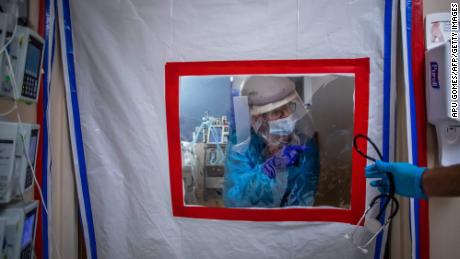
The US has averaged about 228,400 Covid-19 cases a day over the last week as of Thursday — an all-time high, and more than 3.4 times a summertime peak set in late July, JHU data shows.
And the country has averaged 2,764 deaths a day over the last week — the highest figure of the pandemic, according to JHU data.
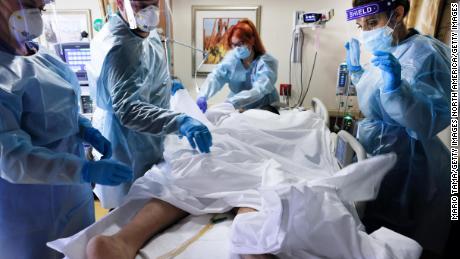
Hospitalizations also are soaring. Some 131,889 Covid-19 patients were in US hospitals on Friday — the third-highest figure recorded, the Covid Tracking Project data show.
No evidence yet of new US variant, CDC and researchers say
“This fall/winter surge has been at nearly twice the rate of rise of cases as the spring and summer surges. This acceleration suggests there may be a USA variant that has evolved here, in addition to the UK variant that is already spreading in our communities and may be 50% more transmissible,” the report said.
So far, there’s no evidence of a US variant, the Centers for Disease Control and Prevention and academic researchers said Friday.
“Significant continued deterioration, from California across the Sunbelt and up into the Southeast, Mid-Atlantic and Northeast, despite low testing rates during the holidays, suggests aggressive community spread,” the task force report said.
But a CDC spokesman said that “researchers have been monitoring US strains since the pandemic began, including 5,700 samples collected in November and December. To date, neither researchers nor analysts at CDC have seen the emergence of a particular variant in the United States” like those identified in the UK and in South Africa.
Trevor Bedford of the University of Washington and the Fred Hutchinson Cancer Research Center, who helps maintain a database of genetic mutations in the coronavirus, said he saw no evidence of a homegrown US strain that is spreading more aggressively.
The CDC did say at least 63 cases of a variant first identified in the UK have been recorded in eight US states. This includes at least 32 cases in California, 22 cases in Florida, three cases in Colorado, two cases in Connecticut, and one case each in Georgia, New York, Texas and Pennsylvania.
The agency says this does not represent the total number of cases circulating in the US, but rather just those that have been found by analyzing positive samples.
Biden intends to release nearly all available vaccine doses
While vaccinations have been happening for several weeks, experts have said it will be months before they’re widespread enough to make a meaningful impact in the pandemic’s course.
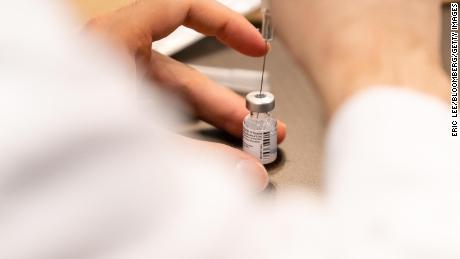
Releasing nearly all vaccine doses on hand could allow more people access to a first dose during a given time.
It could also be a risky strategy, as the vaccines from both Pfizer/BioNTech and Moderna require two doses, administered 21 days or 28 days apart, respectively, and vaccine manufacturing has not ramped up as rapidly as many experts had hoped.
“The second dose is absolutely critical,” Dr. Anthony Fauci, director of the National Institute of Allergy and Infectious Diseases said Friday.
“The President-elect believes we must accelerate distribution of the vaccine while continuing to ensure the Americans who need it most get it as soon as possible. He supports releasing available doses immediately, and believes the government should stop holding back vaccine supply so we can get more shots in Americans’ arms now,” said TJ Ducklo, a spokesman for Biden’s transition.
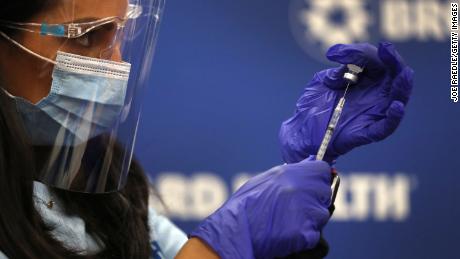
A transition official said the Biden team believes that vaccine manufacturers will be able to produce enough second doses in a timely fashion while administering first doses to more Americans.
The Trump administration has said it’s necessary to hold back doses, to ensure Americans who receive the first course of the two-dose vaccine will be sure to have access to a second dose.
But that had sparked a debate about whether a better strategy would be releasing all available doses as quickly as possible, particularly amid rising death and hospitalization rates.
A study published Monday in the Annals of Internal Medicine found that administering first doses of a Covid-19 vaccine to more people quickly, instead of withholding available supply for use as a second dose, may reduce the number of new cases.
And World Health Organization advisers said Friday that a second dose of Pfizer and BioNTech’s vaccine can be delayed as long as six weeks if need be. That’s based on “currently available clinical trial data,” the WHO guidance document said.
Moderna also believes a second dose of its vaccine can be given effectively 21 to 42 days after the first, a spokesperson for the company told CNN.
Kentucky Gov. Andy Beshear said Friday he agreed with Biden’s plan, but wants “assurances the second dose will be there.”
6.7M first doses administered so far
Some health leaders said states need more money and more staff in order to be able to administer the vaccines fast enough.
Pennsylvania Secretary of Health Dr. Rachel Levine said states, cities and territories had been given just $340 million to build the infrastructure for vaccine rollouts up until the end of the year.
“That is clearly insufficient to accomplishing what we’re trying to accomplish,” Levine said.
The money will be “critical for several aspects of our response,” Levine added, including contracting with companies to do community vaccine clinics.
FDA: New mutations can cause false negative test results in some cases
False negative results can occur with any molecular test for the detection of the virus if a mutation has occurred in the part of the virus’s genome that the test examines, the FDA said Friday.
But the risk that these mutations will impact overall testing accuracy is low, the FDA said. If Covid-19 is suspected after a negative test, repeat testing should be done with a different test, the agency recommends.
The agency noted three Covid-19 tests authorized in the United States may be impacted by genetic variants — MesaBiotech Accula, TaqPath Covid-19 Combo Kit and Linea Covid-19 Assay Kit — “but the impact does not appear to be significant.”
Since the TaqPath and Linea Covid-19 tests detect multiple genetic targets, the overall test sensitivity should not be impacted, the FDA noted. However, if certain patterns emerge in individual results from those tests, labs might consider further genetic sequencing of specimens.
That “may help with early identification of new variants in patients to reduce further spread of infection,” the FDA said in its letter to labs and health care providers, noting that the UK variant has been associated with an increased risk of transmission.
“The FDA will continue to monitor SARS-CoV-2 genetic viral variants to ensure authorized tests continue to provide accurate results for patients,” FDA Commissioner Dr. Stephen Hahn said, referring to the name of the coronavirus that causes Covid-19.
CNN’s Amanda Watts, Sara Murray, Sheena Jones, Michael Nedelman, Cheri Mossburg, Jacqueline Howard, Maggie Fox and Betsy Klein contributed to this report.