
Thailand plans to fully re-open to vaccinated tourists from countries deemed low risk from 1 November, the country’s leader said today, citing the urgent need to save the kingdom’s ailing economy.
Before the pandemic, Thailand attracted nearly 40 million visitors a year drawn to its picturesque beaches and robust nightlife, with tourism making up almost 20% of its national income.
But Covid-related travel restrictions have left the economy battered, contributing to its worst performance in more than 20 years.
Premier Prayut Chan-O-Cha announced today the country will be reopening its borders to vaccinated tourists travelling by air from “low-risk countries”.
The 10 nations considered low risk include Germany, Britain, the United States, China and Singapore.
“When they arrive, they should present a (negative) Covid test… and test once again upon arrival,” the prime minister said in a televised address.
After getting a negative test, “they can travel freely like Thais,” he said.
His announcement significantly loosens up current restrictions in place for vaccinated tourists, who must undergo at least seven days in hotel quarantine.
Thailand’s so-called “sandbox” scheme in Phuket – which allows vaccinated tourists to move freely around the popular beach island – currently requires them to remain there for a week.
Visitors outside of Thailand’s designated 10 low-risk countries are welcome, “but they have to be in quarantine,” said Mr Prayut, adding that more nations would be added to the green list in December.
Earlier this year Mr Prayut had vowed the country would reopen in October, stating its vaccination campaign would be sped up to reach 70% of the population.
To date, 48% of Thais nationwide have received at least a single vaccine dose, while more than 30% have been double-jabbed, health officials said today.
The capital Bangkok – once famed for its nightlife – is still currently under a nighttime curfew, as well as an alcohol ban in bars and restaurants.
Mr Prayut said today authorities will “consider allowing alcoholic drinks in restaurants and reopening entertainment venues under strict health measures” during the New Year’s Eve period – previously a money-maker for the kingdom’s tourism sector.
New Zealand health workers and teachers told ‘no jab, no job’
New Zealand has announced a sweeping “no jab, no job” policy for most healthcare workers and teachers to prevent the spread of Covid-19.
“We can’t leave anything to chance so that’s why we are making it mandatory,” said Covid-19 Response Minister Chris Hipkins, who is also the education minister.
Doctors, nurses and other frontline health workers must be double-jabbed by 1 December while everyone working in the education sector who has contact with students must have their two doses by 1 January.
The Royal New Zealand College of General Practitioners backed mandatory vaccinations with president of the organisation Samantha Murton describing it as a “bold, but necessary call” to make.
Secondary schools will also be required to keep a register to show the vaccination status of students.
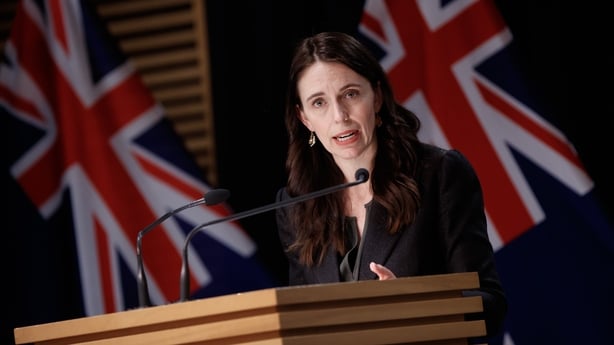
“Vaccination remains our strongest and most effective tool to protect against infection and disease,” Mr Hipkins said.
The order includes home-based educators and parents volunteering at schools, but no decision has been made on whether vaccination will be mandatory in the tertiary education sector.
Before the arrival of the Delta variant in August, New Zealand had won widespread praise for its Covid elimination policy, which had largely protected the country from the pandemic.
Residents enjoyed a near-normal domestic life alongside tight restrictions on international borders.
However, the “Covid Zero” strategy fell apart when Delta was detected in Auckland, New Zealand’s most populated region, and has since spread to the surrounding Northland and Waikato provinces.
Prime Minister Jacinda Ardern said the highly transmissible Delta variant had proved a “game-changer” that could not be eliminated.
Russia vaccination rate ‘unacceptably low’
The Kremlin has described Russia’s Covid fatality toll as “high” and the country’s vaccination rate as “unacceptably” low, even as it rejected new restrictions so as to protect the economy.
Officials today registered 957 new deaths from Covid-19 over 24 hours, bringing the country’s total fatalities to 217,372 – the highest toll in Europe – even as authorities are accused of downplaying the severity of Russia’s outbreak.
Under a broader definition of deaths linked to the virus, the Rosstat statistics agency said that by the end of August, more than 400,000 people in Russia had died with the coronavirus.
The growing toll comes as Russia’s jab drive has stalled. As of today, just over 30% of Russians had been fully vaccinated, according to the Gogov website, which tallies Covid-19 data from the regions.
“Yes, indeed, the level of vaccinations we have is small, unacceptably small,” Kremlin spokesman Dmitry Peskov told reporters, saying that this is the reason for “such a high mortality rate.”

But he dismissed the notion that authorities could do more, saying they had done everything to give the public the chance to “save their lives by getting vaccinated”.
The Kremlin’s task, he added, is to balance limiting the spread of the virus with ensuring that “the economy continues working”.
Independent polls show that more than half of Russians do not plan to get a shot.
Several regions in Russia are also vaccinating pets against Covid-19 – the country registered the world’s first jab for animals last March.
“The use of the vaccine, according to Russian researchers, can prevent the development of viral mutations, which most often occur during interspecies transmission of the agent,” according to regulator Rosselkhoznadzor.
The coronavirus has killed at least 4,843,739 people worldwide since the outbreak emerged in China in December 2019, according to an AFP compilation of official data yesterday.
The United States has suffered the most Covid-related deaths at 712,974, followed by Brazil with 600.829 and India (450,589).
Taking into account excess mortality directly and indirectly linked to Covid-19, the World Health Organization estimates the overall death toll could be two to three times higher.
Malaysia eases travel curbs as Covid outbreak slows

Malaysia eased domestic and international travel curbs yesterday for those fully vaccinated against the coronavirus, as a fierce outbreak slows and inoculation rates rise.
The southeast Asian nation had faced its worst Covid-19 wave in recent months, prompting authorities to impose a tough nationwide lockdown.
But with case numbers falling and the inoculation roll-out picking up speed, authorities began lifting curbs, with businesses allowed to reopen and workers slowly returning to offices.
In a televised address yesterday, Prime Minister Ismail Sabri Yaakob announced fully inoculated people can move freely within the country, as well as fly overseas without special permission.
“According to the ministry of health, the vaccination rate for the adult population… has reached 90%,” he said to explain the move that takes effect today.
Malaysians had been prohibited from travelling between the country’s different states since January, apart from in exceptional circumstances.
Overseas travel had only been allowed for those who got special permission by applying through an official system.
While this requirement is being dropped, returning travellers will still need to undergo quarantine.
The country of 32 million has recorded over 2.3 million cases and 27,000 deaths.