
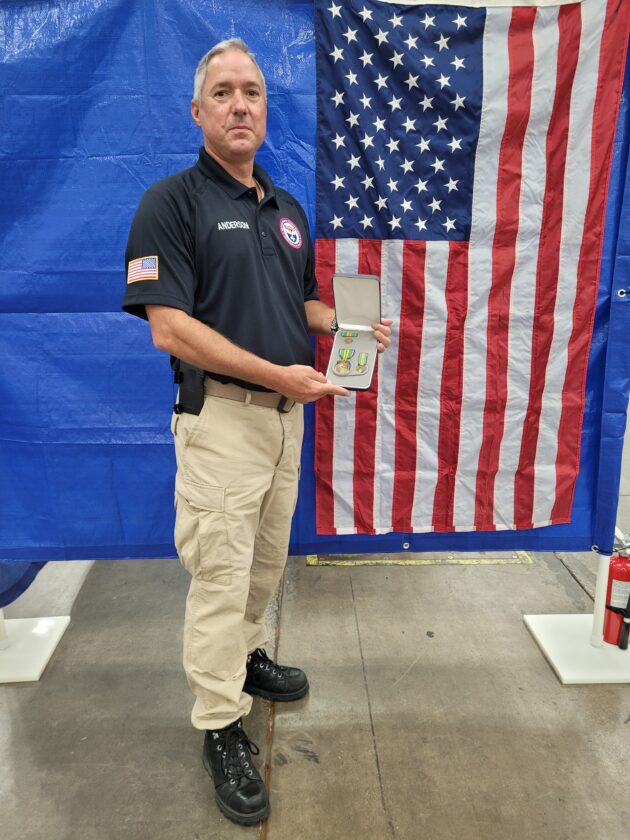
Mortuary Officer Brad Anderson, currently of Summersville, West Virginia, was recently awarded the COVID-19 Pandemic Civilian Service Medal.
NEWELL – Newell native Mortuary Officer Brad Anderson, currently of Summersville, West Virginia, was recently awarded the COVID-19 Pandemic Civilian Service Medal.
Anderson, a civilian employee for the U.S. Department of Health and Human Services’ (HHS), according to an HHS release received the medal for providing exemplary service to the United States as part of the National Disaster Medical System (NDMS) during the federal medical response to the COVID-19 pandemic where he served as a member assigned to the NDMS Disaster Mortuary Response Team (DMORT).
A press release from the HHS describes the NDMS as a federal program that can support communities with medical care, veterinary care and mortuary assistance during disasters or public health emergencies at the request of states; NDMS is among the resources made available by the HHS Administration for Strategic Preparedness and Response (ASPR).
According to Anderson, he initially deployed to Travis Air Force Base in Fairfield, Calif., where he was tasked with repatriating Americans from Wuhan, China back into the states.
During his time at Travis Air Force Base, Anderson was part of the team that received the first two planes of Americans to come back into the country from Wuhan at the onset of the pandemic in February and March of 2020.
Next, Anderson was redeployed back to Marine Corps Air Station Miramar where he was assigned to repatriate the those who were at sea on cruise ships once they were allowed to Dock in San Diego, Calif.
Anderson described the repatriating process as unboarding the planes and ships and getting the passengers quarantined in a secure facility.
At Travis Air Force Base, they overtook a building located on the base to use for quarantining purpose, according to Anderson. Quarantine was a two-week period in which passengers underwent constant testing for COVID-19. Once the two-week period was up and passengers tested negative, they were free to return home.
“At that time things were very novel or new,” Anderson said. “It’s not like it is today where we know a lot more about what goes on with COVID.”
After being at Travis Air Force Base and Miramar, Anderson said he was home for about a week when he was deployed to New York City to set up a morgue facility.
“The Medical Examiner’s Office was overwhelmed. We commissioned a DPMU (disaster portable morgue unit) on one of the wharfs and we set up a morgue facility that alleviated some stress from the office of the chief medical examiner,” Anderson said. “They were overwhelmed with a lot of fatalities.”
When asked about his fear of contacting COVID-19 during this time, Anderson said that due to being intermittent federal employees, the teams were tasked with a lot of ppe (personal protection equipment) so they felt very safe. He also noted that the doctors from the CDC (Center for Disease Control) and staff from the National Institute of Health (NIH) were with them.
“Being that it was very new when it first came out, it was more of a novel thing, so we took extreme precautions,” Anderson said.
Anderson noted on receiving the medal, that it was nice to have the recognition, they didn’t do these things to be recognized.
He also noted that they worked with a lot of people and professionals during this time and they were very blessed and honored to work with them. He also added that there were no individual efforts, it was all a group effort which it was an honor for him to be a part of.
“I was honored and humbled to receive the COVID-19 Pandemic Civilian Service Medal from the Federal Government for exemplary service to the Nation as part of the National Disaster Medical System (NDMS),” Anderson said. “I worked with some of the best professionals from Feb. 1 through May of 2020 the USA has to offer.”
Anderson was awarded the medal during the National Disaster Medical System Training Summit held in Indianapolis, Ind. He was one of approximately 1,400 NDMS responders who was authorized to receive the medal by the U. S. Surgeon General. The medal can be awarded to civilians who have deployed for the purpose of providing medical care to state, territory, tribal or local partners for 30 consecutive or 60 cumulative days, according to HHS.
“The COVID-19 pandemic strained our country’s health care system and medical personnel for almost three years,” NDMS Director Michael Smith said. “Mr. Anderson and his NDMS colleagues served as a lifeline to hundreds of hospitals and long-term care facilities by providing temporary relief to staff, adding bed capacity, and improving outcomes for COVID-19 patients. This medal is reflective of his selfless commitment to the public health and medical needs of our residents.”
The HSS press release also noted that the NDMS has conducted over 1,800 support missions and deployed thousands of medical, logistical and command and control personnel to help nearly 50 states, territories and jurisdictions respond to the COVID-19 pandemic. The teams stand by today ready to provide medical surge support if a resurgence of COVID-19 happens during the fall or winter. Additionally, the teams remain on call to deploy in the event of a natural disaster.
To learn more about HHS’ response to COVID-19, visit https://aspr.hhs.gov/COVID-19/. For information about ASPR and NDMS, visit https://aspr.hhs.gov/NDMS/.
Kgarabrandt@mojonews.com