
While celebrations of the Lunar New Year can be traced back in Chinese history – as early as the period of legendary Chinese ruler Emperor Yao (2356-2255 BC) – this annual festival is now marked by more than a quarter of the world’s population from different cultural backgrounds.
In China, anxiety and loss persist after the recent spike in COVID-19 infections while officials attempt to paint a brighter picture of the health situation.

Members of the Jin Wu Koon dance troupe perform an acrobatic dance during Lunar New Year Celebrations in Sydney on Saturday, 21 January 2023. Source: AAP / STEVEN SAPHORE
The Year of the Rabbit or the Year of the Cat?
In China, the Year of the Rabbit started at midnight on Saturday.
According to the twelve zodiac signs in Vietnamese culture, 2023 is the Year of the Cat, rather than the Rabbit. The first day of the Lunar New Year is called Tết Nguyên Đán.
First new year without COVID-19 restrictions in China
Authorities expect nearly two billion passenger trips during the total 40-day travel season, which is still about 70 per cent of the pre-pandemic travel volume.

People pray at the Chinese temple during the Lunar New Year celebrations in Bangkok’s Chinatown. Source: AAP / Sipa USA
But despite the festive mood in the country, the New Year celebration is again overshadowed by the pandemic.
Local health care in these areas is only very rudimentary, and modern hospitals are often several hours away by car.
But while many stocked up Saturday on colourful blooms at the bustling flower market to welcome the new year and enjoy the Spring Festival, others had a more sombre reason: to mourn loved ones lost in the most recent wave of cases.

People select decorations in Wuhan City in central China’s Hubei Province for the festivities. Source: AAP / AP
“I have friends and family who passed away during this time,” a 54-year-old who would only give his surname, Zhang, said as he clutched a bunch of chrysanthemums, which symbolise grief in Chinese culture.
At the stroke of midnight, many residents did just that, as street vendors did a brisk business of selling chrysanthemums and other offerings into the early hours of Sunday.
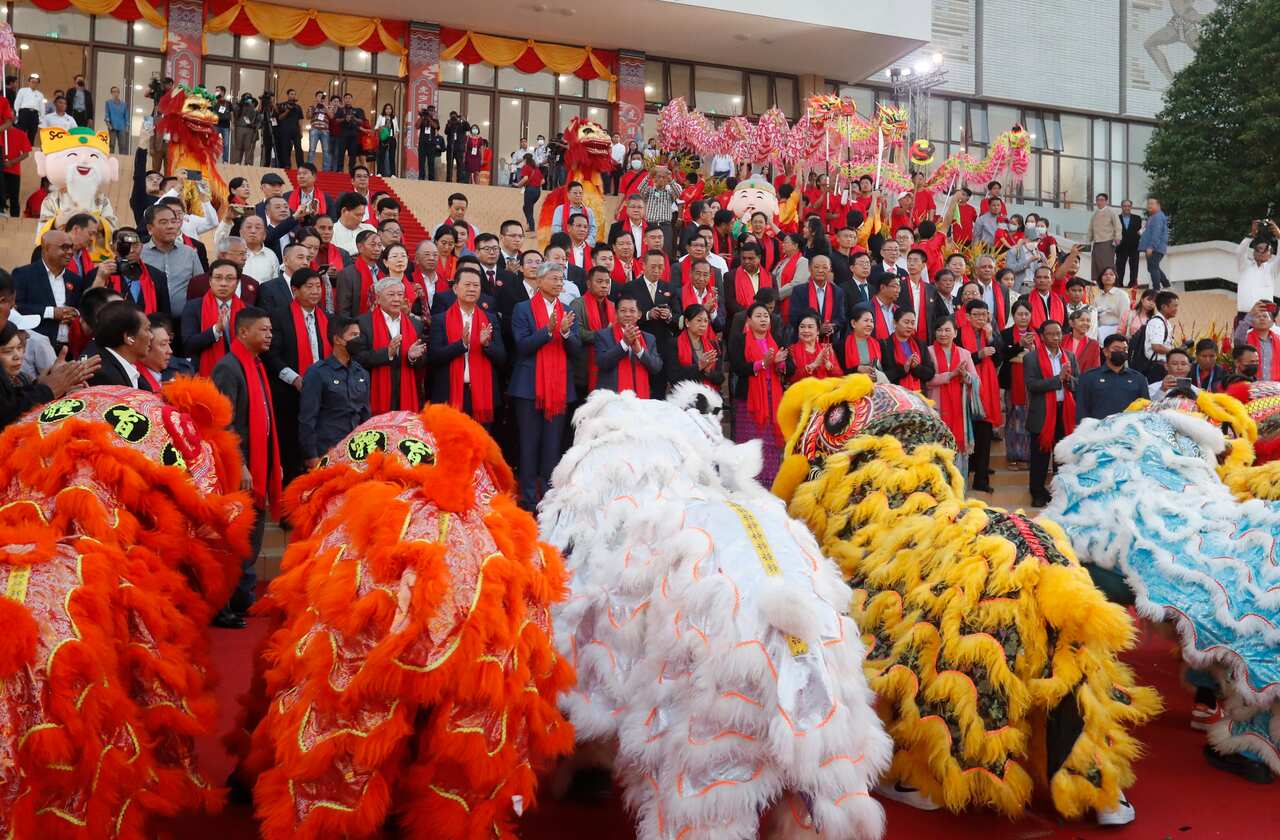
Myanmar military chief Senior General Min Aung Hlaing (centre right) and other officials watch the lion dance performance in Yangon, Myanmar, on 21 January 2023. Source: AAP / EPA
At the same time, fireworks and sparklers popped and glittered in the darkness, despite a ban in place.
The Beijing government lifted its stringent zero-COVID-19 policy in December, but a surge in infections has since ripped through the country, killing thousands.
Deprived of New Year’s Eve festivities, its 11 million inhabitants were cut off from the world for 76 days while Wuhan became the epicentre of an epidemic that inexorably became global.