There’s another new subvariant of omicron rapidly spreading across America, according to the latest data from the Centers for Disease Control and Prevention (CDC). Known as BA.2.12.1, the new strain is a sublineage of the BA.2 subvariant. Here’s what to know about BA.2.12.1 as its spread continues.
- What is BA.2.12.1? It’s a sublineage of the BA.2 subvariant of COVID-19. These subvariants are offshoots of omicron, which the CDC lists as a Variant of Concern (VOC)
- What is a Variant of Concern? It’s a variant that has been found by scientists to be more worrisome than typical variants. The CDC defines a VOC like this: “A variant for which there is evidence of an increase in transmissibility, more severe disease (for example, increased hospitalizations or deaths), a significant reduction in neutralization by antibodies generated during previous infection or vaccination, reduced effectiveness of treatments or vaccines, or diagnostic detection failures.”
- Is BA.2.12.1 more transmissible? NBC News reports the sublineage is 23% to 27% more transmissible than the previous one.
- Does BA.2.12.1 cause more serious disease? The good news is, no, it doesn’t appear to right now.
- How widespread is BA.2.12.1? According to the CDC’s data, as of April 16, 2022, BA.2.12.1 accounts for an estimated 19% of total cases in the United States. (Note, these percentages are based on the agency’s Nowcast tool and are subject to change with future estimates.)
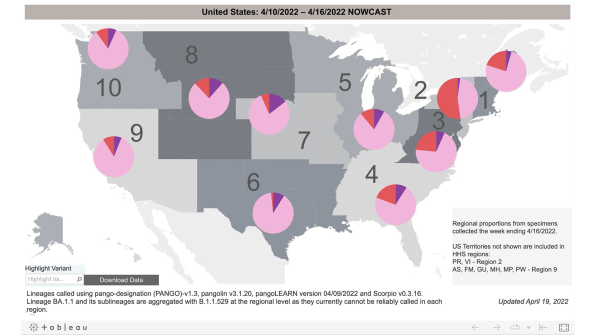
While BA.2.12.1 currently accounts for 19% of new cases in America, different regions of the country have seen the sublineage take hold more rapidly. Here’s how BA.2.12.1’s spread stacks up across the country.
- New York/New Jersey area: BA.2.12.1 makes up over 52% of cases
- Upper Northeast: includes states such as Massachusetts and Maine. BA.2.12.1 makes up over 20% of cases
- West coast: includes California, Washington, and Oregon. BA.2.12.1 makes up over 8% of cases.
- South East: includes states such as North and South Carolina. BA.2.12.1 makes up over 23% of cases.
- South Central: includes states such as Texas and New Mexico. BA.2.12.1 makes up just 1.6% of cases.
- South: includes states such as Florida and Alabama. BA.2.12.1 makes up over 19% of cases.