
Omicron variant cases have been detected in numerous countries, including Canada. No cases have been found in the United States, but many experts says it’s inevitable.
Experts are now racing to determine the answers to these three critical questions:
• Do Omicron’s mutations make it more transmissible?
• Is it more severe or dangerous or deadly than other variants?
• Is it more resistant to vaccines?
It could be weeks before we have the answers.
CNN Chief Medical Correspondent Dr. Sanjay Gupta said Monday that people should get vaccinated or get booster shots — and keep adhering to public health safety measures.
“I think (high filtration) masks and … physical distancing, without the need to shut down, can be very effective until we get a hold of what is really going on here,” he said.
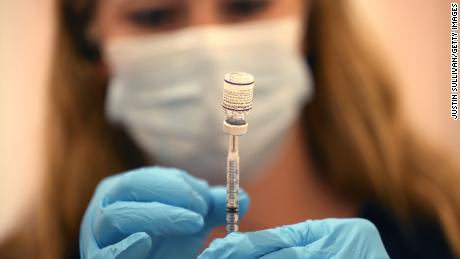
With much about Omicron still unknown, officials say vaccinations and boosters remain the best protection available.
CDC Director Dr. Rochelle Walensky on Monday said the agency is now recommending that everyone 18 and older get a booster shot.
The Omicron variant is another reason for people to get vaccinated and boosted against Covid-19, Dr. Francis Collins, director of the National Institutes of Health, said Monday.
“We still have, of course, in the US a serious surge of the Delta variant, we should be thinking about that,” he said when asked for his best advice regarding Omicron.
Dr. Anthony Fauci, chief medical adviser to President Joe Biden, echoed those comments saying, “Right now we should be focusing on what’s going on in our own country. We have a Delta variant that is overwhelmingly dominant.”
They both said the tens of millions of Americans who are eligible to be vaccinated but haven’t gotten even one shot and the people who are eligible to get boosted should do so.
Critical 2-week timeline
“We have the best vaccine in the world, the best medicines, best scientists, and we’re learning more every single day, and we’ll fight this variant with scientific and knowledgeable actions and speed, not chaos and confusion,” he said.
Biden on Sunday discussed the pandemic’s latest variant with Fauci, the director of the National Institute of Allergy and Infectious Diseases, and other members of his Covid response team.
“Dr. Fauci informed the President that while it will take approximately two more weeks to have more definitive information on the transmissibility, severity, and other characteristics of the variant, he continues to believe that existing vaccines are likely to provide a degree of protection against severe cases of Covid,” a readout of their meeting said.
Fauci told CNN it’s good news that South African scientists are studying the new variant.
“They are as good as it gets when it comes to scientists and public health people, so they’ll be able to give us some very important information, hopefully within the next week or two,” he said, adding it’s too early to tell how severe Covid caused by the variant can be.
Fauci said health officials have every reason to believe — based on experience with other variants — that the current Covid-19 vaccines will promote antibody levels that will have some effect on the Omicron variant even though it is extraordinary and unusual because of the number of mutations to the virus.
“If you get the level on antibody high enough, the protection spills over,” he said.
Moderna expects to know in a couple of weeks whether the new Omicron variant impacts the efficacy of its vaccine, its chief medical officer said Sunday.
If the company finds it needs to pivot and produce a new vaccine, Moderna is working on several approaches, including one that would be specific to the new variant, Dr. Paul Burton told CNN’s “Newsroom.”
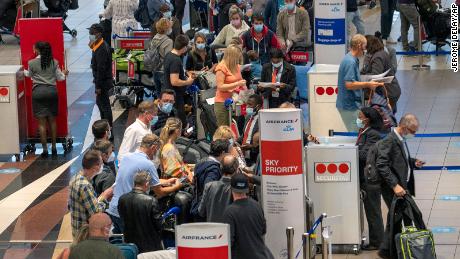
“Our platform, we can move very fast. We think within weeks to maybe two to three months we would be able to have an Omicron-specific vaccine booster available for testing, and then for administration,” he said. “This is going to go at the fastest possible speed, but we have to do careful science now. We don’t want to misstep.”
BioNTech, the German company that partnered with Pfizer to make a Covid-19 vaccine, is also investigating Omicron’s impact on their vaccine, with data expected in the coming weeks.
The CEO of Pfizer, Albert Bourla, said on CNBC’s “Squawk Box” on Monday that he thinks the company’s vaccine will work against the Omicron variant, but that it could offer less protection.
Bourla said Pfizer has started working on a new vaccine in case it’s needed. The company has made the first DNA template, the first part of the development process for a new vaccine.
Johnson & Johnson said it’s also testing the effectiveness of its vaccine against Omicron.
It’s too early to tell what the effect of the Omicron variant will be on protection from vaccines and previous infection, but there is reason to believe Pfizer’s antiviral pill could still work, said Collins of the National Institutes of Health.
There are two ways to figure this out: laboratory experiments and seeing what happens in the “real world,” he said.
“So, in South Africa, where some people are vaccinated and now that the virus is finding its way into other countries, can we start to see what the effectiveness is of the vaccine in preventing illness and particularly severe illness?” Collins said. “That will also take us a week or two to begin to see.”
US travel restrictions go into effect
Since the variant was first identified, it has also been found in Botswana, Belgium, Canada, Australia, the Netherlands, Denmark, the United Kingdom, Portugal, Germany, Israel, Italy, the Czech Republic and Hong Kong.

But Sunday, the US Travel Association urged the Biden administration to reconsider the restrictions.
“Covid variants are of concern, but closed borders have not prevented their presence in the United States while vaccinations have proven incredibly durable. That is why America’s travel industry is a vocal proponent of everyone getting a vaccine,” the association said in a statement. “With a vaccine and testing requirement in place to enter the US we continue to believe that assessing an individual’s risk and health status is the best way to welcome qualified global travelers into the United States.”
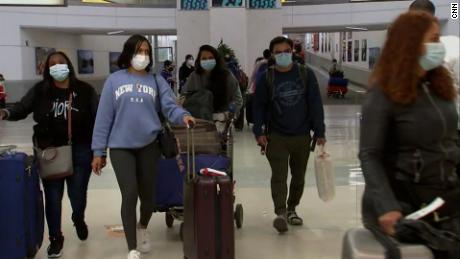
In the meantime, passengers arriving Sunday morning at Newark International Airport on a direct flight from Johannesburg described the impact of global travel restrictions.
Kyle Bogert, of Hoboken, New Jersey, told CNN the rest of his family was still stranded in South Africa because their connecting flight through Dubai was canceled as they were on the way to the airport.
“On the news, you hear about all these variants popping up in different locations and you hear about airports getting shut down. … It’s kind of in the back of your mind until you’re there and you’re stuck there, or your family is stuck there,” he said.
Passengers on Bogert’s flight were advised to get tested for Covid-19 “within three to five days,” he said, noting his exit from his flight was otherwise “normal.”
CNN’s Nikki Carvajal, John Bonifield, Michael Nedelman, Frederik Pleitgen, Naomi Thomas, Pete Muntean and Sarah Fortinsky contributed to this report.