
- The world still sees outbreaks of malaria, yellow fever, cholera, influenza, HIV/AIDS, tuberculosis and polio.
- The rush of daily news does not sweep history off the page. It amplifies it.
- This column has dealt with the history of masks, social distancing, quarantines, treatments, vaccines, hygiene and other ways that Texans have responded to plagues.
Today’s Think, Texas column is dedicated to remembering the echoes of plague in this state.
For no matter how fervently we may wish to put it behind us, COVID-19, in its multiplying variants, is not going away.
History instructs us that is not how plagues work.
I was thinking of this historical prudence — learned and re-learned since ancient times — as I waited a few minutes for a jab of the new bivalent COVID booster at our local pharmacy.

And as I was planning to speak about Texas plagues for a Travis County History Day event built around the theme of pandemics.
To prepare for that speech, I looked back at six Think, Texas columns published since March 2020. Let’s revisit those six columns here.
Comparing COVID to the global flu
March 7, 2020: “During the worst pandemic in modern times, Austin shut down for almost a month“
In early March 2020, Austin city leaders announced that South by Southwest had been canceled.
It was the first major American event shuttered to prevent the spread of COVID. Within weeks, cities and towns across Texas — indeed, around the world — closed schools, shut down public gatherings, and curtailed many kinds of personal business.
Hospitals filled up. Streets emptied. Loved ones suffered catastrophic health consequences, and many died, often without the physical comforts of friends and family.
Scientists attempted to explain the new plague to a public sharply divided on whom to believe about what.
While all this seemed new to many Americans, the scene sounded vaguely familiar to those familiar with 20th-century history.
In fact, a search of newspaper archives showed that Texans responded in remarkably similar ways during the fall of 1918, when the global flu entered the second, and deadliest, of its three waves. This quick-acting illness struck young people particularly hard, so military bases and schools saw astronomical numbers of sick and dead within days.
Already, more than 100 years ago, public health leaders knew about the efficacy of masking, social distancing and quarantining for combatting an airborne plague.
The flu struck high and low: Gov. William P. Hobby withdrew to Beaumont to recover. Others were not so fortunate. Their ethnicity sometimes left them unnamed in the media, segregated and left without public dignity even in death.
One advantage for Texas cities, including Austin: Civic leaders had recently built new, modern hospitals. Although they lacked the antibiotics to fight the secondary infections, hospital leaders put hygienic practices into place in special wards for flu patients.
At the time, as with most plagues in history, groups outside the dominant culture were scapegoated for the medical tragedies. Medieval folks wrongly accused Jews and Muslims, or blamed “Satan” or “an angry God,” for six waves of the bubonic plague. Americans in the early 20th century pointed their fingers at immigrants from other countries.
In Texas, comparatively low population densities and wide open spaces probably saved the state from the worst of the global flu, which returned with predictable results in the winter of 1919.

How Texans responded to other plagues
April 8, 2020: “Texas History: Waves of disease have broken across the state“
Looking to the Texas past for further insights into COVID for a column dated a month later, I consulted the free Handbook of Texas Online, created and maintained by the Texas State Historical Association. The entry on “Epidemic Diseases” was written by Chester R. Burns and revised by Heather Green Wooten. By April 2020, it included a section on COVID.
Allow me to quote just a few passages from that column that made our 21st-century plague sound less singular:
Yellow fever: “Galvestonians experienced at least nine yellow fever epidemics between 1839 and 1867. The events of a yellow fever epidemic terrified everyone. A 25-year-old man would be healthy one day and dead three days later, changing relentlessly from a state of debility, fever and pains in the extremities and loins, to a stage of vomiting blood clots — called the black vomit — to jaundice and death.
“During a yellow fever epidemic in Galveston in 1853, approximately 60 percent of the 5,000 residents became sick and 523 persons died.”
Cholera: “Though cholera appeared in 1833 and caused some deaths, it was far more destructive during an epidemic in 1849. Approximately 500 deaths from cholera had occurred in San Antonio by May of that year.”
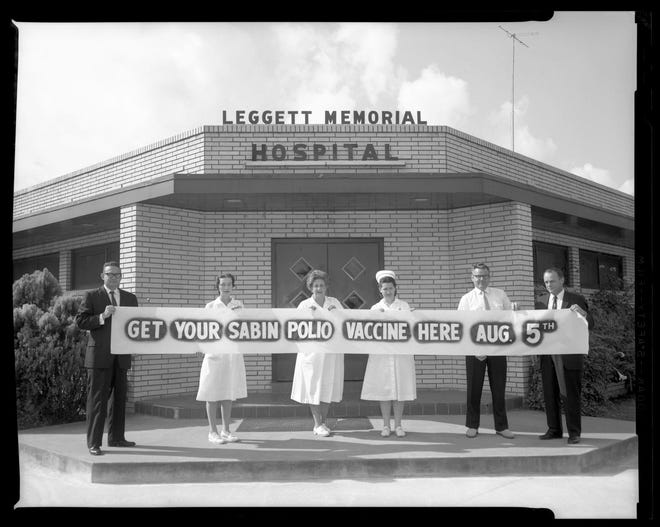
Polio: “During the summer of 1943, 1,274 cases of poliomyelitis (infantile paralysis) were reported. At the time, it was the largest number ever recorded in the state. There were 168 deaths in this group. The total number of cases in 1943 more than doubled the cases reported in 1937.
“The (polio) epidemic in 1943 was most intense in the Panhandle. There were 996 cases confirmed for the entire state during 1945, and 66 counties reported 292 cases during the first six months of 1946.
“In Houston during 1948, 313 new cases were documented. The summer of 1952 was the worst epidemic period for both Texas and the nation as a whole. In the midst of a blistering heat wave, Texans watched the state polio totals climb to almost 4,000 cases.”
What remained remarkable about dozens of such entries: The Texas plagues were often localized by geography or communities. Yet as we learned from HIV/AIDS, just because a community is first identified with a new disease does not mean it will be the only one to be affected.
One Texan predicts and then records the plague
June 18, 2020: “How Austin’s Lawrence Wright predicted this pandemic in his latest work of fiction.”
Of all the unlikely stories, perhaps the eeriest was the the arrival of Lawrence Wright’s novel “The End of October.” Finished in the summer of 2019 — and published in April 2020 — it deals with a COVID-like virus and the terrifying scientific, political and military consequences.
Journalists like myself treated Wright as a sort of pre-COVID seer, but in fact, the scientists that he had befriended over the years and then scrupulously consulted for this novel knew exactly what was likely to happen.
“Well, it’s not surprising that what’s happening in real life parallels what I wrote in the novel, because that’s what medical experts said would happen,” Wright told me. “I read the briefing books and I interviewed the experts, and they laid it out pretty clearly.
“It’s not prophecy, Michael, it’s just digging in, doing the research: What would happen if something like the 1918 flu appeared? Would we be any better prepared than our ancestors? There are some lucky guesses and coincidence involved.”
Did leaders read his novel for guidance? I did not note public evidence of that.
Aug. 3, 2021:“Pick up these prime books about our Lone Star State”
Wright was not done. In 2021, he put out “The Plague Year: America in the Time of COVID,” one of the best point-by-point analyses of the first months of our nonfictional crisis.
“Wright’s access to scientists, planners and medical personnel is a priceless asset,” I wrote in my column. “Yet just as welcome — and valuable — is his ability to synthesize the news in ‘The Plague Year.’ He also reflects thoughtfully on the changes in his life during the past months.”
For a reminder of how our leaders did respond, read Wright’s key synthesis.

July 2, 2020: “Living in historic times translates into more attention to history“
It occurred to me in the midst of the COVID crisis that renewed attention to disease — along with subjects such as political violence and systemic racism — meant that reporters, columnists, broadcasters and others were also delving more frequently — some for the first time — into history in fresh and discerning ways.
Rather than just mention SARS or MERS or other recent epidemics, for instance, journalists working across multiple media were delving deeper into the background of the global flu and even the bubonic plague. More and more, they were treating history as news.
After all, we have inarguably been living in historic times.
March 22, 2021: “When COVID-19 ends, will Texans suffer the same amnesia that followed 1918 pandemic?”
During the hopeful spring 2021, when many of us thought COVID was behind us, I looked at how quickly the general public had put aside the terrible toll of the global flu of 1918-1919. There are virtually no physical memorials to the victims of that plague, for instance.
Why did it become the “forgotten plague”?
“We forget (it) — one of the most consequential events of the 20th century — largely because it doesn’t fit our sense of what a ‘big’ event looks like,” said Mark Lawrence, director of the LBJ Presidential Library. “We think of disease as a matter for scientists and physicians — part of the natural world. We tend to think of history, by contrast, as what people do. So an event like the First World War draws massive interest from historians, while the flu does not. Only in recent times have historians begun looking at the ways in which natural processes — especially disease and environmental forces — shape human affairs.”
COVID has transformed the planet in countless ways. People are still dying from COVID. New strains pop up every few months.
While science can lend us hope, history can help us prepare for the outcomes.
Michael Barnes writes about the people, places, culture and history of Austin and Texas. He can be reached at mbarnes@statesman.com. Sign up for the Think, Texas free, weekly newsletter at statesman.com/newsletters.