
A recommendation that people wear masks in indoor public places extended Thursday to more than half of Arkansas’ counties as the state — for the second time this week — posted its largest increase in hospitalized covid-19 patients since January.
After increases of 31 on Tuesday and six on Wednesday, the number hospitalized rose Thursday by 33, to 376, its highest level since March 4.
Before this week, the last time the number rose by more than 30 in a single day was Jan. 26, during the state’s first surge of infections from the omicron variant.
The state’s count of cases rose Thursday 1,907, which was larger by 97 than the rise a day earlier and by 113 than the one the previous Thursday.
The state’s death toll from the virus, as tracked by the Department of Health, rose by four, to 11,624.
“It is unclear why hospitalizations have had such a big increase this week,” department Director Dr. Jennifer Dillaha said in an emailed statement.
“It may be a combination of the recent increase in cases and the fact that hospitalizations are a delayed indicator. It is also possible that the number of cases in the community that are not being reported to ADH are increasing at a faster rate than the cases that are being reported.”
She said she isn’t concerned about the state’s hospital capacity in the near future, but added that it “may become an issue if this upward trend continues in the long run.”
Health Department spokeswoman Danyelle McNeill said only one of the deaths reported Thursday happened within the past month.
Of the others, she said, two occurred in February and one was from May.
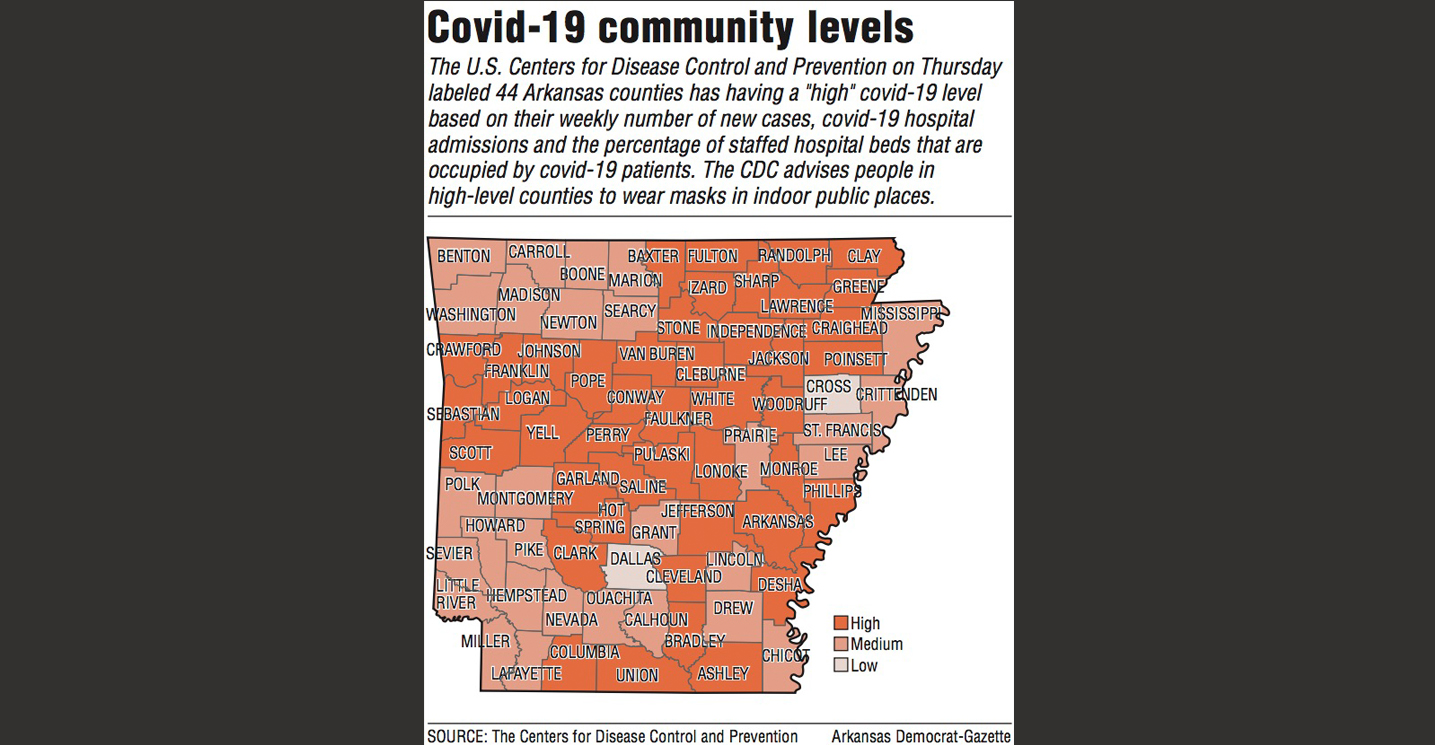
Reflecting the rising hospitalizations, as well as the state’s new case numbers, the number of Arkansas counties considered to have a “high” level of covid-19 — triggering the recommendation to wear masks — rose Thursday from 16 to 44.
The change meant that about 66% of Arkansas residents were living in a county where the covid-19 level is considered high, up from 33% under the previous weekly update to a U.S. Centers for Disease Control and Prevention map.
The last time more than half the state’s counties were subject to a mask recommendation was in late February and early March, just after the CDC’s guidelines based on “covid-19 community levels” were first unveiled.
At that time, a mask recommendation was in effect for 42 Arkansas counties, representing 60% of the state’s population.
The levels — low, medium or high — are based on a county’s weekly number of new cases, covid-19 hospitalizations and the percentage of staffed hospital beds that are occupied by covid-19 patients.
The state Health Department has recommended Arkansans check the level in their county to determine what precautions they should take.
“If they’re in a county with [a] high [covid-19 level], then they should wear masks when they’re out in public indoors,” Dillaha said earlier this week.
Among Arkansas’ 13 most populous counties, only Benton and Washington were not subject to a mask recommendation as of Thursday.
The covid-19 level for both counties was listed as being medium, with hospital admissions in an area encompassing the two counties as well as Madison County falling just below the level that would have raised it to high.
In counties with a medium covid-19 level, the CDC recommends people who are immunocompromised or at high risk of severe covid-19 talk to their health care providers about whether they should wear masks or take other precautions.
People in those counties also should consider wearing masks around people who have a high risk of severe illness, according to the CDC.
In counties with low covid-19 levels, the CDC doesn’t have a recommendation about whether people should wear masks.
Just two Arkansas counties — Cross and Dallas — were labeled as having a low covid-19 level on Thursday, down from 25 under the previous weekly map update.
The number of counties with a medium level fell Thursday from 34 to 29.
Nationwide, about 54% of the U.S. population lived in a county with a mask recommendation as of Thursday, up from 32% under the previous weekly map update.
CASES BY COUNTY
Within Arkansas, Pulaski County had the most new cases, 325, on Thursday, followed by Benton County with 118 and Washington County with 106.
The state’s cumulative count of cases since March 2020 rose to 883,331.
After dipping on Wednesday, the average daily increase in the state’s case count over a rolling seven-day period rose to 1,439, which was still down from a recent high of more than 1,500 a day that the average reached on Tuesday.
Already at its highest level since Feb. 14, the number of cases in the state that were considered active rose Thursday by 629, to 15,857, as new cases outpaced recoveries.
After not changing a day earlier, the number of the state’s virus patients who were in intensive care rose by six, to 64, surpassing the recent high of 59 that the number reached a week earlier.
The number as of Thursday was the largest since March 19.
Growing for the fourth day in a row, the number of covid-19 patients who were on ventilators rose by four, to 18, the largest number since April 8.
Arkansas Children’s Hospital in Little Rock and Arkansas Children’s Northwest in Springdale had a total of 17 covid-19 patients on Thursday, up from 14 a day earlier, spokeswoman Amanda Leech said.
In Jonesboro, St. Bernards Medical Center had 21 covid-19 patients, including three who were in intensive care and one who was on a ventilator, spokesman Mitchell Nail said.
The total number of patients spiked just after the Fourth of July, he said. Since then, it’s been hovering in the 20-25 range.
“A lot of our patients, they’re being hospitalized for other reasons, as well,” Nail said.
“They may happen to test positive for covid, but that may not be the primary reason they’re in the hospital. That’s a good thing, but any time you have something like that, it can exacerbate a situation.”
The number of patients as of Thursday had yet to reach the heights it did during previous waves of infection, including an all-time high of 128 during the winter omicron surge.
“We are thankful that covid is not creating outrageous hospitalizations, but it’s something we’re keeping an eye on,” Nail said.
 Covid-19 community levels