
allanswart/iStock via Getty Images
The number of births in the U.S. increased for the first time in seven years to 3.66M, up 1% from 2020, according to preliminary statistics from the Centers for Disease Control’s National Center for Health Statistics.
Still, the number of births has been on an overall downward trend since about 2007. Since 2014, the number of births has declined by an average of 2% per year from 2014 to 2020, and fell by 4% from 2019 to 2020.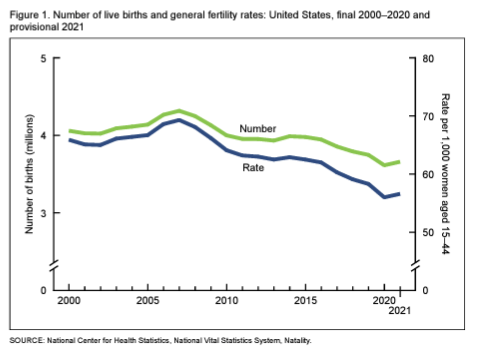
The number of births is important because economic growth primarily relies on the size of the U.S. population and productivity improvements. And the pandemic has limited the immigration of people from other parts of the world coming into the U.S.
The general fertility rate was 56.6 births per 1,000 women aged 15-44, up 1% from 2020, and like the total number of births was the first increase since 2014.
The total fertility rate (“TFR”) was 1,663.5 births per 1,000 women, up 1% Y/Y. That’s still below the replacement rate of 2,100 births per 1,000 women, or the level at which a given generation can exactly replace itself, the CDC said. TFR has generally stayed below the replacement rate since 1971 and consistently below replacement since 2007, according to the CDC data. TFR estimates the number of births that a hypothetical group of 1,000 women would have over their lifetimes, based on the age-specific birth rate in a given year.
As for immigration, only 247K people, net of emigration, moved into the U.S. in the year ended July 1, 2021, the most recent year for which data was available, according to the U.S. Census Bureau. That’s down from 477K between 2019 and 2020, which overlapped with the start of COVID-19. In the previous decade, immigration reached as high as 1.05M between 2015 and 2016.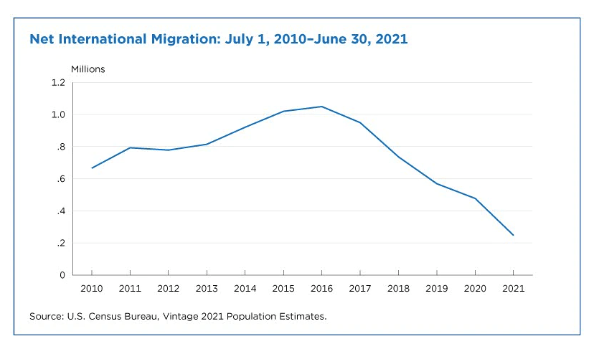
The birth rate, though, turned out better than some were predicting at the beginning of the pandemic. Some economists predicted that the health crisis and economic shock would lead to 300K-500K fewer births in 2021. Phillip Levine, an economic professor at Wellesley College told the Wall Street Journal that a rebound in the labor market and government fiscal support that boosted household spending helped ward off a larger pandemic dip in births.
2021 was the first year since 1937 that the U.S. population increased by fewer than 1M, the Census Bureau said. In 2019, the U.S.’s population growth rate slipped to the slowest pace in 100 years.
See why SA contributor Daniel Moser calls the 2022-2026 outlook for Carter’s (CRI), maker of baby apparel, “conservative but constructive.”