
The World Health Organization (WHO) has cautioned that the coronavirus pandemic is still ongoing, and there could still be more to come.
Dr. Soumya Swaminathan, the organization’s chief scientist, told reporters while on a visit to a vaccine manufacturing facility in South Africa that she expects more variants will follow.
“We have seen the virus evolve, mutate … so we know there will be more variants, more variants of concern, so we are not at the end of the pandemic,” Swaminathan said during the visit along with WHO Director-General Tedros Adhanom Ghebreyesus.
Her comments come as countries around the world have begun to roll back COVID-19 restrictions following the omicron variant onslaught, which was marked by less severe cases.
A pattern of exponential spikes in the infection rate was experienced as the highly infectious variant spread following its discovery by South African scientists in November.
However, there has not been a corresponding spike in death rates compared with earlier variants, which has led to a level of optimism that perhaps the worst of the COVID-19 pandemic may be over.
Here are the latest major developments on coronavirus from around the world:
Europe
Chancellor Olaf Scholz of Germany said Friday that the surge in COVID-19 infections is peaking, which could mean an easing of restrictions.
“The scientific forecasts show that the high point of the wave is in sight,” Scholz told parliament.
“That will allow us to look at the first steps at reopening during a meeting next week between the federal government and the states, and then further steps for spring,” Scholz said.
On Friday 240,172 new infections were recorded over a 24 hour period signaling the first week-on-week decline since the start of the year.
Russia on Friday explained why it had placed French President Emmanuel Macron at the end of a large table during talks with President Vladimir Putin.
Kremlin spokesman Dmitry Peskov said the decision was made because Macron had refused to take a COVID-19 test, which would be administered by Russian medics.
“Talks with some are being held at a long table, the distance [across the table] is about six meters,” Peskov said.
“It is linked to the fact that some follow their own rules, they don’t cooperate with the host side,” he added.
Sources in the French presidential entourage confirmed the incident with Reuters news agency, saying that refusal of Russia’s request meant sitting at opposite ends of the table.
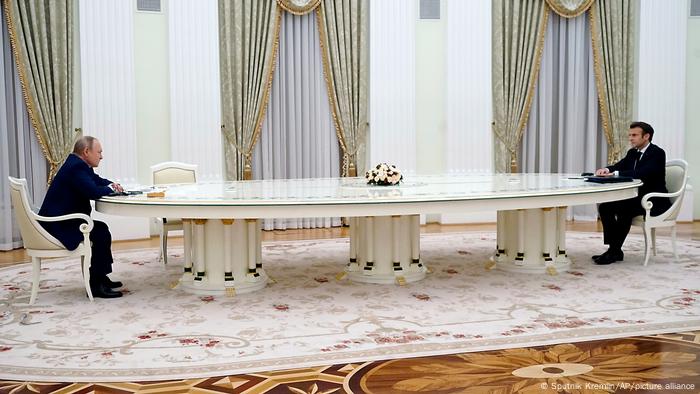
Macron (right) was in Moscow for talks with President Vladimir Putin to discuss the troops buildup on Ukraine’s border
The United Kingdom will again be allowing vaccinated travelers to begin entering the country on Friday.
British Transport Secretary Grant Shapps said the UK “now has one of the most free-flowing borders in the world, sending a clear message that we are open for business.”
Travelers who have received two shots of an approved vaccine will need to fill out a passenger locator form prior to arrival in the UK.
Unvaccinated travelers will be required to test before and after arriving but will not have to self-isolate until they record a negative result.
The move has been welcomed by the travel industry following two years of severe restrictions.
kb/wmr (AP, AFP, Reuters)